Given the heavy teaching load (and I mean heavy... some days it feels downright unmanageable), my intention to present at three conferences over this year, and the need to take the dissertation material in an entirely new direction in order to make it into a workable book, I'm insane to have agreed to join our re-started fiction writing group.
Insane.
And yet.
I'm buying myself a little time by sending off material that's already been roughly drafted (though not completed by a long shot). Which means that I spent some of the last part of this week running through a first chapter draft, trying to eliminate the most awkward prose (not worrying so much about story at this point - that will have to come later).
Weird thing is, I really, really enjoyed it.
I also found myself becoming interested in the story again. I had started it quite a while ago, but got stuck after the fourth chapter (they're long, so it's about 2/3 to 3/4 of the way through a book-length manuscript). And so I left it. And left it.
But I'm actually getting interested in it again. I still don't know how to get out of the fourth chapter and into the final one(s). But I'm beginning to suspect that in the process of editing what I've already got, I'll figure it out. And that feels pretty good.
Now to get back to the conference paper that has a real and hard deadline that's rapidly approaching, rather than the agreed-upon deadline of the writing group!
Sunday, October 03, 2010
Friday, September 24, 2010
Lazy professors
The Chronicle writes today about the myth of the lazy professor in an attempt to debunk it, and the responses are interesting in that they tend to simply reinforce it.
Much of the counter arguments against the lazy professor focus on how busy professors feel their jobs to be (not something I'm arguing with, though I find it interesting that this was the dominant form of evidence produced). In response, one commenter suggests that professors feel overworked because they have no idea what life is like in the "real" world. Another suggests that the only way to not feel overwhelmed as a professor is to learn to let unimportant deadlines lapse and to accept doing a "mediocre" job in most things, while yet another suggests that the myth arises because people who have bosses imagine what they would do if their boss wasn't watching all the time and then suppose that professors slack off the same way they would.
The first one, of course, makes me laugh. I've worked in the "real" world at a similarly high-motivation job, and although I always had way too much work to do there, I still felt much less compulsion to work evenings or weekends to compensate. I just prioritized and kept going, which meant that things got done when they got done. As a professor, I am far more invested in the job because I see it as an extension of myself, it's my identity, and so I am far more inclined to put in extra hours because it reflects back on me. (Interestingly, adjusted for inflation between that job and my current one, my compensation was roughly the same...)
The second one about doing a mediocre job is a bit disturbing, but only because it sounds like "mediocre" is less than excellent. When one understands that the "mediocre" mentioned is probably what a perfectionist means by mediocre (since in my experience, as a profession, academics tend toward perfectionism), then a perfectionist's "mediocre" might be pretty damn good. Then again, the writer may be one of those "deadwood" professors we always hear about. But giving the benefit of the doubt, it's possible that the writer feels like his/her output is mediocre, but those looking at the product probably think it's pretty stellar.
The last observation struck home with me though because from an outsider's perspective, the life does look pretty easy. First, there's little direct oversight (or at least very little that's directly observable from outside the institution). What little performance evaluation the public might see is on sites like RMP, in which even professors identified as "bad" by students remain in a job for years. Of course, the evaluations of students on RMP are problematic, which is why they aren't always a good indicator of effectiveness.
Second, even when oversight seems to be in place, the visible portions of a professor's job - the time spent in the classroom - seem minimal. Six hours a week? Doesn't seem like much, does it. Even the 13 hours a week I'm in the classroom sounds pretty small. But of course imagining that's all there is to the job is similar to imagining that the time spent on stage by any performer is all the time spent on the job. So U2 make millions for a few hours work three or four days a week while they're on tour? Not really. Then again, maybe a rock group like U2 isn't a good example since what they make for all they do is proportionally still much larger than a professor. But even an actor in the local playhouse, who makes much less, puts in many, many more hours than those spent on the stage. The job involves much more than just the performance itself.
Third, if indeed the myth is believed by people who imagine what little work they'd be able to get away with doing if they didn't have a boss, then we're talking apples and oranges when it comes to mindset. If you can imagine you'd do much less work without a boss, then you don't have the same mindset as a professor, who tend as a group to be highly self-motivated. In fact, I would suspect that if as professors we had bosses looking over our shoulders every day, we'd actually do less work. The work I do, I do because I'm motivated to do it, not because I know someone else is watching. If someone else was watching, I might not do as much because I'd probably resent the implication that I was not the best judge of what I should be doing with my time. That's what years and years of post-secondary education will do for you. There's so little structure in place to monitor professorial output because they don't need it, not because they are lazy and are avoiding it.
Personally, I don't know that the myth of the lazy professor is that prevalent, though perhaps the people I meet just are too polite to express it to my face. But it nevertheless serves as excellent fodder for Chronicle articles so that those both from within and without can reinforce as well as counter it.
Friday, September 17, 2010
Tech school saves the day!
I keep thinking up blog posts when I'm in no position to blog (driving, walking to class etc.) but they don't get written because my life is pretty full of being a teacher right now.
Those three new preps are keeping me busy, but I'm also keeping on top of them, so it's good. So far.
But since time's the source of non-blogging, it seems appropriate to blog about saving time.
I have a non-credit upgrading course for students who aren't ready to take university level English. Foolishly, I thought something that looked like a grade 12 curriculum would be fairly easy to organize (not to teach mind you, just to put together) because I'd be able to use a lot of material from different periods, genres, and places. I figured I'd then be able to use nothing but texts with which I'm already familiar.
That of course turned out to not be the case since there are some pretty strict requirements for the structure of the course. But I did figure out how to make the prep for that course easier.
I've discovered that the first year writing course I taught at the tech school I was at is actually at the right level for an upgrading class, which means that at least the assignments and exercises we did will be suitable. Hooray! I fairly danced when I figured out I had a set of in-class exercises that would do what we needed to in this class already prepared from the previous one.
Now, it should be obvious at this point that there's something amiss here. Materials that I first developed for students in a post-secondary first year writing class will be useful in teaching students who perhaps have not even finished high school. But yes, the level of preparedness of the students at that tech school and the one I'm at now are radically different. And what I can expect from my students (even the non-credit ones) here is slightly higher than what I could expect from my students at the other school.
In theory, one would hope that an introductory English class at one school is relatively similar to that at another. But in reality, that's not always the case. On that level, this observation is a sad one.
But, boy, am I glad to have found some ready-made materials that just need a little tweaking to help me prep for this class!
Sunday, September 12, 2010
De-feet and teaching
I'm looking through my shoes, trying to decide what to wear tomorrow so that I'll survive the day. I have 5 hours solid in the classroom, and that pretty much means 5 hours of standing, so I need something with a bit better support than last week. After the first day of teaching, my legs ached from the unaccustomed standing.
I did walk a lot over the summer, but I also sat a lot. I didn't stand in one place (or relatively one place) much though, and the 3 hours of teaching last week made my legs and hips sore.
I realize you might be thinking, "why don't you just sit down while you teach?" but frankly, that's always struck me as a bit odd. It seems too casual somehow, and I wonder if students at the back of the room might get distracted because they can't see me properly.
I know some of my colleagues regularly sit during lectures, but that just feels too casual. I also move constantly throughout the room during exams. I don't want to catch cheaters - I hope none of my students feel the need to cheat. But I also think that many students cheat because it's an opportunity crime. They see someone else's answer sheet and copy. Or they see that the teacher isn't watching and pull out their phone. I figure if I'm constantly moving through the classroom, varying the pattern of my movement, I keep them on edge and less likely to be tempted.
Besides, I've been in a class as a student where others were blatantly cheating because the prof was seated at the front of the room with his head in a book. That really ticked me off, and there was no way to even catch his eye because he didn't look up at all. I can't help but think that if he had circulated through the room, those students wouldn't have cheated. /rant
I actually had a student comment on my standing last semester. He seemed surprised that I never sat down during class - apparently many of his other profs did.
But I like to move around at least a bit, so I end up standing a lot. I do sometimes sit on top of a desk while we're having a discussion because I often don't need to actively participate in them when the students start talking to each other. But when I'm lecturing or leading the discussion, it seems necessary to be able to maintain eye contact with anyone in the room, and being on the same level as they are would make that hard.
Perhaps it's odd, and maybe at some point I'll find it too hard and have to sit. But right now, I need good shoes to stand in for 5 hours...
Thursday, September 09, 2010
I LOVE teaching!
Okay. I have to say it, and I have to say it now, because I know the bloom will be off the rose very shortly.
But I had a *great* first day!
This, despite the fact I have an 8am class (Brit Lit II survey... some strange scheduling there!). I don't like mornings. 9am classes are good. I'm not one of those people who complains if I have to come in before noon. But there's something about getting up that one hour earlier that gets tougher and tougher as the semester progresses.
But today? I had a fabulous day. I met the survey class students bright and early, and all but one were there are ready at 8am. And I had two former (non-major) students signed up. The course is open enrollment as long as you meet the pre-reqs, but I was still a bit surprised to see their names on the roster. I wonder if they realized they got me? As part-time, my name doesn't go into the calendar, so they might not have known originally.
Then again, maybe they knew it was me and came for that reason. Who knows?
My GenEd students in the afternoon looked kinda sullen for much of the class - you know, the syllabus explaining, schedule distributing part - but at least some of them perked up with the brief discussion we had at the end of class. I can see some potential conflicts between strongly held beliefs ahead though.
But I also got some interesting responses when I had them fill out a short questionnaire indicating why they chose this class. I had a few of course who said it was the best of the three horrible options they had, but I also had some who seemed genuinely enthused and thought it would relate back to their majors, which is what GenEd is about after all, so by the end of the class I was pretty excited (but tired!)
I actually had to cut off the discussion to end the class, so we might get some good give and take going, as long as I can keep some of the dominant ones (I can see some of them already) in check to allow other points of view.
But it was a very satisfying day overall.
Only problem is, now I have to get ready for the other two classes. Here's hoping they're as enjoyable (at least in this first week) as this one was!
Tuesday, September 07, 2010
Bad rhetoric
A recent article at the CHE on teaching got me thinking about rhetoric, so I thought I'd share. From the opening paragraph:
Then the third sentence contrasts teaching with recreation and research, which by implication suggests that teaching has not had money lavished upon it or the latest technologies installed in classrooms. That's where I have a problem with this introduction because it sets up a false comparison. It pits recreation and lab equipment against teaching "equipment" and technologies. But most teaching is still the interaction between teacher and student, an embodied, sometimes visceral, most often corporeal interaction. And even in online learning, the use of language by the student and teacher, even when facilitated by electronic rather than face to face means, is still intensely personal.
I don't mean that student and teacher become friends, or even that their language use is colloquial and intimate (though the colloquial does occasionally emerge (and I hope the intimate does not)), but that the process of teaching is one human being sharing knowledge and experience with another. There's little need for fancy doodads and gadgets to make that happen.
And yes, it's not like teaching doesn't need support through resources and technologies. But the crux of the relationship - a mentoring one many times - is still one human being talking to another. And all the bells and whistles in the world won't change that.
That's what annoys me about these kinds of false oppositions. They lose sight of the very different kinds of activities that research (labs), recreation, and teaching/learning encompass.
With lavish recreation centers and sophisticated research laboratories, life on college campuses is drastically different from what it was 100 years ago. But one thing has stayed virtually the same: classroom teaching.In all fairness, the quote does go on to talk about how the work of the professor, to design lessons and evaluate has stayed relatively the same, but the parallelism of the first sentence: "lavish" recreation centers and "sophisticated" research labs implies resources have been poured into these two areas. And by resources one gets the sense that the structures that house recreation and laboratory activities have gotten the latest upgrades, including the latest technologies possible.
Then the third sentence contrasts teaching with recreation and research, which by implication suggests that teaching has not had money lavished upon it or the latest technologies installed in classrooms. That's where I have a problem with this introduction because it sets up a false comparison. It pits recreation and lab equipment against teaching "equipment" and technologies. But most teaching is still the interaction between teacher and student, an embodied, sometimes visceral, most often corporeal interaction. And even in online learning, the use of language by the student and teacher, even when facilitated by electronic rather than face to face means, is still intensely personal.
I don't mean that student and teacher become friends, or even that their language use is colloquial and intimate (though the colloquial does occasionally emerge (and I hope the intimate does not)), but that the process of teaching is one human being sharing knowledge and experience with another. There's little need for fancy doodads and gadgets to make that happen.
And yes, it's not like teaching doesn't need support through resources and technologies. But the crux of the relationship - a mentoring one many times - is still one human being talking to another. And all the bells and whistles in the world won't change that.
That's what annoys me about these kinds of false oppositions. They lose sight of the very different kinds of activities that research (labs), recreation, and teaching/learning encompass.
Thursday, September 02, 2010
This is gonna be some ride!
 After being yanked rather reluctantly from my own research back into the realization that the semester is soon upon us, I realized that it was high time I started prepping courses since there's lots to do yet. I may be in for quite a ride this semester.
I only have one conference this semester, unlike some when I've had as many as two conference papers to produce, so I've been trying to finish off that paper. It's roughly sketched out, but still needs a really good draft completed before we get to the point where classes start.
Speaking of classes, because I have three new preps in the four courses I'm teaching, I have a lot of new material to develop. I'm teaching the survey class again, which is good and the only thing I changed was the novel. I switched from Doris Lessing's The Antheap to R.L. Stevenson's Jekyll and Hyde, which I'm much more conversant with, so that's not a big deal. But I also have the poetry course, my gen ed course in "making humans" (which I'm VERY excited about!) and an upgrading course. This means I have to:
- read and develop lectures/discussion activities questions for 4 novels I've read before
- read and develop lecture material/activities for a novel I've never even read before (thank goodness it's a short one)
- read a Shakespeare play - Othello - that I haven't read in years and develop a drama unit for the upgrading class
- write 9 new assignments - of these, two will be versions of a research paper, so I only need to tweak existing research assignments, but that still leaves 7 new ones (this doesn't include exams unfortunately)
- prepare about 4 dozen poems for discussion/lecture materials
- read and prepare lecture/activities for half a dozen short stories
When I sat down to put together the syllabus for the upgrading class, a lot of the material that I had in front of me from which to fulfill the requirements was material that I haven't taught before, so a lot of the new reading comes from this course alone. I'm still looking forward to most of that reading and the challenge of developing the material, but it will be a lot of work!
The bright spot in all this is that my two lit classes - poetry and the survey - are not full, so I should have fewer papers to mark in those than usual, and the fact that I'm not teaching any composition also means I'll have less marking to do than I usually have. In fact, the upgrading course - which will probably require the most handholding on my part - consists of a number of unit tests as well as a couple of shorter writing pieces, so the marking in it should be fairly light as well.
Sunday, August 29, 2010
Summer, where are you?

I refuse to turn on the furnace before September. I refuse to turn on the furnace before September. I refuse to turn on the furnace before September. I refuse to turn on the furnace before September. I refuse to turn on the furnace before September. I refuse to turn on the furnace before September.
Thursday, August 26, 2010
Finished... sort of...
Finished all 4 syllabi for this semester - hooray!
I say I sort of finished them because although the actual syllabus is finished for each class, there are many, many assignments yet to write - I think I've got about a dozen new ones this semester - and I don't feel like I've finished the syllabus until I've at least drafted what I want those assignments to say.
Funny how I don't feel the same need to write exams ahead of time, but writing assignments and presentations I do.
Thursday, August 19, 2010
Academic Sponges
 When I think of a metaphor to describe my academic career, I sometimes think of a sponge.
I know that's not terribly pretty, and depending on your experience with sponges, it might even be slightly disgusting, reminding you of clean up jobs that you'd rather not remember. But think of it as a nice clean washing sponge or the sort that one might have used before the advent of the ubiquitous loofah sponge. You know, the ones the size of small dinner plates with all those lovely big holes in them.
Anyway. I sometimes feel like my academic career to this point has been like a sponge, soaking up other people's ideas. In classrooms, at conferences, reading books and articles, I feel like I always know so very little about what people are talking about that I just soak it all in.
As a sponge, every once and a while I get a poke, and some of what I've soaked up comes back out in the form of a conference paper or an article, and a really big poke (by my committee to some extent but mostly a self-imposed impatience to finish things) resulted in the dissertation.
Of course this creates a problem that I think I've mostly shed at this point, but that haunts me nevertheless. Because some of what I read wasn't necessarily smart or useful. Especially during my undergraduate career, some of the things I chose to read for research papers and the like wasn't always good.
Which has me wondering how I might integrate more critical analysis of sources into my classes so that my students don't base their research on shoddy sources. I'm thinking of incorporating a research proposal into my lit classes and maybe even the gen ed one so that I have the opportunity to engage in conversation with students about the sources they are considering useful to their projects and steer them away from the superficial or less useful ones. If nothing else, such an exercise should result in better research papers, even if it does little for the student's understanding of quality scholarship and ability to critically analyze sources.
At least, that's what I'm thinking.
Wednesday, August 18, 2010
Forecast: flurries
No, the Great White North is not going to be getting snow in August... though the way the weather's been so changeable this summer, I wouldn't be surprised. Not that I want it to snow...! *knock on wood*
No, it's a flurry of emails over the last three days that I suspect will just continue to snowball.
It's our first week 'back' at the university, even though classes don't start for another three weeks, and suddenly my daytimer is filling with events/meetings and I've gotten emails from pretty much every department on campus, welcoming me back.
Not to mention the emails about contracts that still need to be drawn up and signed over the next few weeks, and last minute class assignments that now need syllabi and textbook orders. (I'm keeping my fingers crossed that the bookstore can get them in on time, though they should have plenty of time)
It feels like I went from merrily working away on my scholarship last week to a sudden need to finish syllabi (actually, it's mostly just finishing schedules at this point) and start teacher-thinking mode instead. It's a bit of a jarring transition, and the urgency of some of that email flurry isn't helping matters!
Thursday, August 12, 2010
Going back and seeing familiar faces
 I've been thinking about the 'going back' phase of summer. It's that time when August is in full swing and I start to think about the upcoming semester.
Sometimes there's a sense of panic because I haven't gotten as much done over summer as I had hoped. Sometimes it's with anticipation at teaching a new course.
This year, I've both got new courses - including one that is essentially teaching the dissertation (and I'm not even on the tt track!) - and the panic isn't manifesting since I had almost no expectations for work this summer and what few ones I did have are fulfilled.
I am a little confused and dazed as I try to figure out where to go next with the dissertation. But that makes the prospect of focusing on teaching for a bit pleasant as it will be a distraction from the problem of what to do next and I suspect sometime during that distraction an idea will emerge that will be worth following up on.
I'm also eager to meet my students this year. The class list for one of my classes isn't posted yet, but of the other two, I spotted a few familiar names, and I'm looking forward to getting to know these students in a new class.
Recognizing names on a list is one thing. But I've also been running into my colleagues in some of the most unexpected places. I met two colleagues - one from my department and one from another one - when I was on the coast for vacation. They weren't together, so seeing familiar faces in two different places on the same day was odd. Then two days later and 300 kms away, I bumped into another colleague when we stopped in a small town for lunch. Apparently we all like vacationing in similar places! Finally, I met another colleague last night at a restaurant in town that just opened two weeks ago.
Familiar faces and familiar names. Frankly, I can't wait to go back!
(I know, I know, remind me of this post in a couple of months and I won't believe I wrote it, but there it is!)
Tuesday, August 10, 2010
When did the twenty-first century begin?
At a recent conference - the first I'd ever seen on twenty-first century literature - I found myself surprised by how many speakers referenced 9/11 as one of the markers for the beginning of the century.
Hmmm....
I was frankly a bit surprised by it and so much so that I feel the need to blog about it by wondering at the markers that signal literary periods. Aside from the gloominess of defining a century by its disasters, what really surprised me the most is that almost every person who mentioned 9/11 in the context of a marker of the twenty-first century was not American.
That surprised me because I guess I hadn't thought of the disaster as being indicative of the century. This is of course partly because I work in representations of science and technology (and by extension, science fiction), so I tend to think in timelines that involve technological change or scientific paradigm shifts and such. But falling so soon after the beginning of the century, the 9/11 event does seem an ideal marker.
But at the same time that it makes it easy to mark off centuries of literature according to the calendar, there are exceptions.
Of course there's the long eighteenth century... Although I'm not a specialist in this area, I realize that there are long discussions (often at the curricular level) about what constitutes eighteenth century literature.
And the nineteenth century often gets chopped into two separate sections because a "long" nineteenth century is really, really long, so that we have the Romantics and the Victorians (at least on the English side of the house).
Even the twentieth century has been divided fairly consistently between the early part of the century, sometimes defined as pre-WWII, but more often associated with the modernist style that developed shortly after the century began, and the post-WWII or "postmodern" period. (There are problems with the label postmodern, but I don't want to take that detour right now)
So then, where does this post-WWII period or postmodern period end (i.e. where does the twentieth century end) and where does the twenty-first one begin?
Standing so close to that line, wherever it might be drawn, makes it difficult to see it, and certainly most of the lines we've drawn through the literature of the past have been assigned to those periods long after they were over. The benefits of hindsight operate healthily in this respect.
But where does the twenty-first century begin?
Y2K?
1989?
9/11?
Now you might be wondering, 1989? What's up with that?
Well, there were several events in 1989/1990 that might make it valid to include the last decade of the twentieth century in the twenty-first, depending on how things unfold as we continue into this century, of course. 1989 was the year of Tiananmen Square and the fall of the Berlin Wall, both events that changed the political landscapes of the East and the West
On the literary front, the fatwa against Salman Rushdie for The Satanic Verses, although not the first case of attempted censorship through violence, was certainly widely reported and the upsurge of anti-Western sentiment that has built since then certainly attests to the critical effect of such beliefs in the world.
On the scientific front, the Human Genome Project was conceived in the late eighties, with an official start date of 1990. Although it seems somewhat anti-climactic now, at the time, the promises of genomics seemed endless and the project was hailed as a marvel that would allow us to cure all kinds of diseases. (Even though the promise of the project seemed to offer more than it delivered, it was that promise and the envisioned new future that seems to me to be a marked break with the more mundane visions of science in the post WWII period. But I can be wrong.)
So, when did the twenty-first century begin?
It's a question whose answer I'm hoping to watch unfold over my career. And that's exciting to me.
Monday, August 02, 2010
Organizational woes
I think I've mentioned before that I signed up for Library Thing in order to keep track of my books (and because I suspect if I ever have to make an insurance claim, the company won't believe me when I tell them the number of books I own). I also signed up for Movie Collector Plus for the same reason.
But I've had to juggle book space a lot in the last few years, which means I sometimes know that I own a book, but can't figure out which bookshelf it's on! Which means I need to spend long periods of time scanning shelves looking for something that's not where it used to be.
So, the question is: would it be extravagant to buy a RFID system to keep track of them?
Just wondering...
Saturday, July 31, 2010
Addressing website audiences
Gearing up for the fall semester and the job hunt, which means cruising university websites on a regular basis, this illustration seems absolutely appropriate:
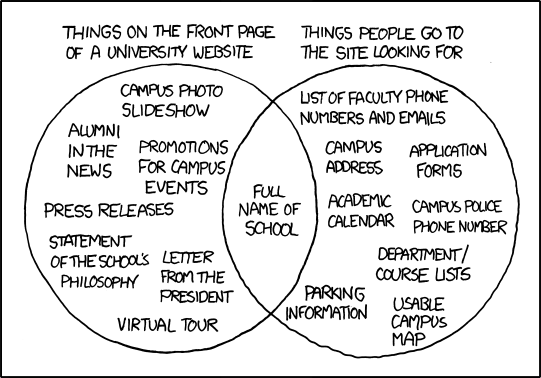
It also reminds me of the kinds of things clients have wanted on their opening pages for elearning projects: statements of purpose, information about the genesis of the project, almost-vacuous statements about what this elearning project will do for you. The latter I really doubt as being useful since people will end up on the page because they've been told to, or because they know what advantage it will provide.
At the same time that I take the point the illustration is making, that there's a kind of generic expectation of websites that their first pages will be filled with this kind of fluff. And it makes a certain kind of sense, just like the acknowledgments page is often the first one in a book, but of limited interest to many readers (or the copyright page for that matter).
Besides, how would one fit all of those things in the right-hand circle that people are looking for on to one page? The difference between the right-hand circle and the left, is that the left is written for a generic kind of reader - an ideal one - who doesn't really exist (or if they do, it's only a few individuals who are looking for this information). Actually, as a job seeker, those statements of purpose can be very handy for getting a grip on what the university thinks of itself and what kind of teaching will take place there, so perhaps the information in the left-hand circle really is more useful than the illustration implies.
But the problem with making the information on the right-hand circle the primary page is that it addresses at least three different audiences: staff and faculty of the school, students at the school, and outside parties interested in attending/visiting the school. That's a lot of audiences for one page to address and address effectively.
The way webpages are conventionally set up, there's a large space near the middle, intended to address the audience interested in the page. But when you've got several audiences, which one would you privilege? This is why those primary pages often include navigation that separates users into functions, i.e. "for students" "for alumni" "for faculty" etc. in order to then address that audience and only that audience in that next level of webpage.
So I take the point of the illustration that much of what's on the left-hand side of it is information few are interested in. But given the number of different users of a university website, it seems that such general pages are by default the best use of the first page.
Wednesday, July 28, 2010
Empty
My house is feeling quite empty these days. It has been moving toward that state for a while, but more so this last week after youngest daughter moved out.
It's odd. I realize that objectively, the house is not really changed since her departure. Yes, she took a couple of small pieces of furniture and her personal items with her. But my sense of the house being empty is more subjective. I realize there are no children in house anymore and they won't be living with me again.
They visit. In fact, two called on Monday to say they wanted to come over, so we had dinner together (the third was out during the day and too tired to come by, or everyone would've been here). That spontaneous get together was nice. But it also reinforced that they are gone. At the end of the night, they both left for their own homes.
Some days I don't notice it. But on others, I feel like a ping pong ball, bouncing around inside the shell of the house.
Monday, July 19, 2010
Archive Fever
"Contemporary culture is increasingly conscious of its own present as the object of a future memory"
Mark Currie, About Time: Narrative, Fiction, and the Philosophy of Time
Mark Currie, About Time: Narrative, Fiction, and the Philosophy of Time
Saturday, July 17, 2010
The Masterworks Meme
The Masterworks Meme, from The Speculative Scotsman via The World in a Satin Bagcharts some of the must reads of a science fiction education. So. In bold, the books I've read. The books I own but haven't yet read are italicised.
NB: Some of the SF Masterworks were released in a line of special hardcovers - denoted by roman numerals - as well as the paperbacks we all own a few of, so there are a few duplicates in the list.
II - The Left Hand of Darkness - Ursula K. Le Guin
III - The Man in the High Castle - Philip K. Dick
IV - The Stars My Destination - Alfred Bester
V - A Canticle for Leibowitz - Walter M. Miller, Jr.
VI - Childhood's End - Arthur C. Clarke
VII - The Moon Is a Harsh Mistress - Robert A. Heinlein
VIII - Ringworld - Larry Niven
IX - The Forever War - Joe Haldeman
X - The Day of the Triffids - John Wyndham
1 - The Forever War - Joe Haldeman
2 - I Am Legend - Richard Matheson
3 - Cities in Flight - James Blish
4 - Do Androids Dream of Electric Sheep? - Philip K. Dick
5 - The Stars My Destination - Alfred Bester
6 - Babel-17 - Samuel R. Delany
7 - Lord of Light - Roger Zelazny
8 - The Fifth Head of Cerberus - Gene Wolfe
9 - Gateway - Frederik Pohl
10 - The Rediscovery of Man - Cordwainer Smith
11 - Last and First Men - Olaf Stapledon
12 - Earth Abides - George R. Stewart
13 - Martian Time-Slip - Philip K. Dick
14 - The Demolished Man - Alfred Bester
15 - Stand on
16 - The Dispossessed - Ursula K. Le Guin
17 - The Drowned World - J. G. Ballard
18 - The Sirens of Titan - Kurt Vonnegut
19 - Emphyrio - Jack Vance
20 - A Scanner Darkly - Philip K. Dick
21 - Star Maker - Olaf Stapledon
22 - Behold the Man - Michael Moorcock
23 - The Book of Skulls - Robert Silverberg
24 - The Time Machine and The War of the Worlds - H. G. Wells
25 - Flowers for Algernon - Daniel Keyes
26 - Ubik - Philip K. Dick
27 - Timescape - Gregory Benford
28 - More Than Human - Theodore Sturgeon
29 - Man Plus - Frederik Pohl
30 - A Case of Conscience - James Blish
31 - The Centauri Device - M. John Harrison
32 - Dr. Bloodmoney - Philip K. Dick
33 - Non-Stop - Brian Aldiss
34 - The Fountains of
35 - Pavane - Keith Roberts
36 - Now Wait for Last Year - Philip K. Dick
37 - Nova - Samuel R. Delany
38 - The First Men in the Moon - H. G. Wells
39 - The City and the Stars - Arthur C. Clarke
40 - Blood Music - Greg Bear
41 - Jem - Frederik Pohl
42 - Bring the Jubilee - Ward Moore
43 - VALIS - Philip K. Dick
44 - The Lathe of Heaven - Ursula K. Le Guin
45 - The Complete Roderick - John Sladek
46 - Flow My Tears, the Policeman Said - Philip K. Dick
47 - The Invisible Man - H. G. Wells
48 - Grass - Sheri S. Tepper
49 - A Fall of Moondust - Arthur C. Clarke
50 - Eon - Greg Bear
51 - The Shrinking Man - Richard Matheson
52 - The Three Stigmata of Palmer Eldritch - Philip K. Dick
53 - The Dancers at the End of Time - Michael Moorcock
54 - The Space Merchants - Frederik Pohl and Cyril M. Kornbluth
55 - Time Out of Joint - Philip K. Dick
56 - Downward to the Earth - Robert Silverberg
57 - The Simulacra - Philip K. Dick
58 - The Penultimate Truth - Philip K. Dick
59 - Dying Inside - Robert Silverberg
60 - Ringworld - Larry Niven
61 - The
62 -
63 - A Maze of Death - Philip K. Dick
64 - Tau Zero - Poul Anderson
65 - Rendezvous with Rama - Arthur C. Clarke
66 - Life During Wartime - Lucius Shepard
67 - Where Late the Sweet Birds Sang - Kate Wilhelm
68 - Roadside Picnic - Arkady and Boris Strugatsky
69 - Dark Benediction - Walter M. Miller, Jr.
70 - Mockingbird - Walter Tevis
71 - Dune - Frank Herbert
72 - The Moon Is a Harsh Mistress - Robert A. Heinlein
73 - The Man in the
74 - Inverted World - Christopher Priest
75 - Kurt Vonnegut - Cat's Cradle
76 - H.G. Wells - The
77 - Arthur C. Clarke - Childhood's End
78 - H.G. Wells - The Time Machine
79 - Samuel R. Delany - Dhalgren
80 - Brian Aldiss - Helliconia
81 - H.G. Wells - Food of the Gods
82 - Jack Finney - The Body Snatchers
83 - Joanna Russ - The Female Man
84 - M.J. Engh - Arslan
*I'm in the process of reading this one, but just about finished
Since I've begun to read science fiction again, it seemed appropriate to play along and wonder about how many of these I'd read, owned, and have yet to read. Not bad.
Since I've begun to read science fiction again, it seemed appropriate to play along and wonder about how many of these I'd read, owned, and have yet to read. Not bad.
Thursday, July 15, 2010
Peripatetic estrangement
 One of the civilizing effects of travel is often thought to be the exposure to different cultures in order to develop an appreciation for the global and realization that the local is, well, indeed, local, and not the only way to skin a cat, so to speak. Hence, the Grand Tour that the gentrified encouraged their (male) progeny to embark upon before settling down to run their estates, or the updated "year off" or "year abroad" backpacking through Europe that is supposed to perform a similar function for the more nouveau gentrified classes in North America.
I won't argue that time in another country is not valuable. It certainly helps to remind you that there is indeed more than one way of doing things and whether the cultural differences you encounter are only mildly odd or downright baffling in their strangeness, they can be enlightening.
[Having read that last sentence, you'll notice that I used the word "can" rather than "are" since in this age of all-inclusive resorts and whirlwind Europe-in-a-week (complete with tour guide) travel options, one can remain blissfully unaware of those differences if one so desires]
But there's also an estrangement that happens when you return home. I know my parents spoke of the "reverse culture shock" they experienced when we returned from our two year stint in Brasil. Since I was young, I certainly noticed differences (though the things I noticed were no doubt very different than the ones my parents did), but for the most part, there was little "shock" in them.
When we returned from living in the U.S., I certainly noticed cultural differences, particularly in the media and in accents, but even traveling to the Caribbean last year or Europe, there was a moment - when I first got into my own car actually - when I felt estranged from my own culture. Most of that seemed to be centered on the enormous size of our vehicles here, which seemed bloated and bullyish as I navigated streets near my home.
But there's also a sense of a shifting pace that contributes to that estrangement as you move from the pleasure- and transport-centered activities of travel, to the more circumscribed and sedentary activities of work and house maintenance. The vivid everyday activities of the other country are slowly replaced by the mundane and repetitive sameness of the same city, job, and house as you slip back into the ordinary. It's not a bad thing, just a strangely transitional place to be.
Wednesday, July 14, 2010
Placeholder
First google decided I was some kind of spammer and blocked me out of all my accounts. Then I left for vacation. That's my explanation for the radio silence.
Yes, it's a touch pathetic and pedestrian. But such is life.
More anon.
Yes, it's a touch pathetic and pedestrian. But such is life.
More anon.
Subscribe to:
Posts (Atom)